
May 2013 Improving learning and enrolment at Al-zahra Girls School Kwardu

GRACE Association Pakistan in collaborations with Australian High Commission Islamabad
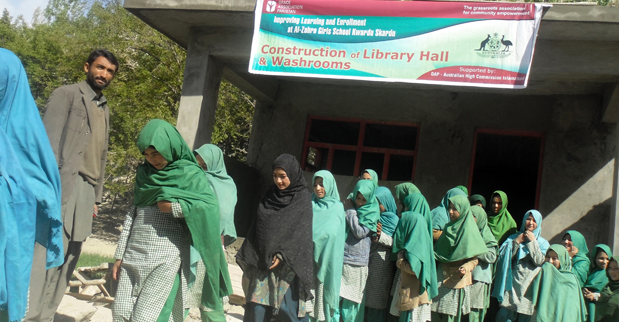
Our project is teachers training, learning hall and latrine block construction and the old school building renovation
Government investments in health, education, infrastructure and economic development of disadvantaged communities in remote and rural areas have sharply decreased over the last years. Today, an increasing number of people live in severe poverty. These developments have inevitable negative implications on the most vulnerable and underprivileged groups of society such as women and children in rural areas.
The northern region of Pakistan has been particularly hit by the aforementioned consequences. Rural communities and particularly girls lack essential primary education. Thanks to the efforts of community-led schools, a small percentage of children receive primary education and have access to basic schooling facilities in some rural villages. Nevertheless, a quarter of children cannot complete their primary education and around 35 per cent of children do not attend school at all. Unfortunately, without proper educational and professional guidance, children do not receive the essential analytical tools that would help them realize their full potential in life. More importantly, lack of good quality primary education contributes to the cycle of poverty in Pakistan, which worsens the long-term problems of poverty and illiteracy. But, we at GRACE Association believe that the aforementioned problems can be tackled by helping community led primary schools.
GRACE Association Pakistan in collaborations with Australian High Commission Islamabad is helping the Al-Zahra Girls School to increase enrolment, retention and improve learning outcomes. The school has been established in 1992 as the first girl school when it was considered a sin by parents to send their girl to school. The school is running by the village community based organization, called WAFA in Kwardu Skardu.
Our project is constructing a learning hall, latrine block for the school. The existing old school building is renovated and teachers training conducted for Al-Zahra and neighboring school teachers.
This project will have long-term benefits for the whole community. The student will obtain an improved educational quality and physical environment. With the improvements and rehabilitation of the premises, drop-out rates will significantly be decrease as more parents will send their daughters to school, which will result in higher enrolment rates among girls. The provision of sanitary latrines and upgrading sanitary services and providing sanitary education will help minimizing the risk of infectious/disease among children and their families.
