GRACE Celebrates Alumni Excellence: Fatima Batool Inspires the Next Generation of Achievers

MDCAT 2026 Top Achiever Returns to Her Alma Mater to Share Her Journey of Determination, Hard Work and Academic Excellence

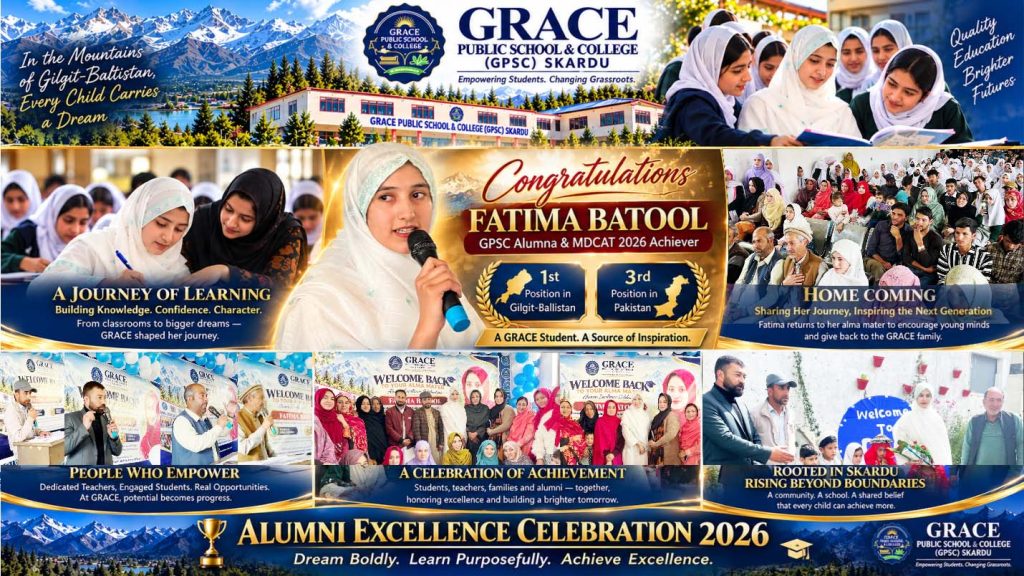
Skardu, October 7, 2026: GRACE Public School & College (GPSC), Skardu, organized a memorable Alumni Excellence Celebration 2026 to honor its outstanding alumna, Fatima Batool, who secured 1st position in Gilgit-Baltistan and 3rd position in Pakistan in MDCAT 2026.

The celebration brought Fatima back to her alma mater, where her educational journey began. The event recognized her remarkable achievement while inspiring current students to pursue their academic dreams with determination, discipline and confidence.

Held at the GPSC Conference Hall, the ceremony welcomed Fatima, her parents and siblings, distinguished educators, school leadership, teachers and students from Grades 7 to 10. Among the guests were Wazir Zamin, DDO Skardu and Headmaster of High School No. 1 Skardu, and Muhammad Qasim, founding member of GRACE Association and graduate teacher.

A Journey of Determination and Gratitude

Sharing her inspiring success story, Fatima emphasized that determination, effective time management, consistent preparation, parental encouragement and teachers’ mentorship were central to her achievement.

She expressed heartfelt gratitude to GRACE Public School & College for nurturing her academic foundation from early childhood education through secondary school.

Fatima recalled how her teachers encouraged curiosity, continuous reading, hard work and goal-oriented learning. These early experiences helped shape her confidence, discipline and commitment to academic excellence.

Addressing students, she acknowledged that examination stress is natural, particularly during competitive examinations such as MDCAT. However, she encouraged them to set clear goals, develop realistic study schedules and follow their preparation plans consistently.

“Determination, proper planning and effective time management are essential to achieving our goals,” she emphasized.

Celebrating the Role of Parents and Teachers

Fatima’s father expressed sincere appreciation to GPSC teachers, management and leadership for their contribution to his daughter’s educational journey and remarkable achievement.

Guest speaker Wazir Zamin congratulated Fatima and encouraged students to learn from her example. He emphasized dedication, perseverance and academic discipline while appreciating GRACE Public School and other educational institutions that contributed to her success.

Mustafa Aqeel, Principal of GPSC, reflected on Fatima’s academic journey, recalling how her curiosity, determination and ambitions had always impressed her teachers.

“We always believed in Fatima’s potential and encouraged her to pursue her goals. Alhamdulillah, she has made us proud, and we are confident she will continue achieving greater success,” he remarked.

Inspiring Future Achievers

An engaging question-and-answer session allowed students to interact directly with Fatima. They asked about academic goal setting, MDCAT preparation strategies, study routines, time management and overcoming examination stress.

Fatima responded warmly, sharing practical lessons from her personal experience.

Muhammad Ejaz, Vice Principal and event organizer, thanked the guests, parents, teachers and students for their participation. He appreciated Fatima for becoming an inspiring role model for younger learners.

Honoring Excellence, Inspiring Futures

The celebration concluded with the presentation of the prestigious GRACE Public School & College Alumni Excellence Award 2026 to Fatima Batool, followed by refreshments and high tea.

More than an award ceremony, the event reaffirmed GPSC’s commitment to quality education, character development, lifelong learning and nurturing students capable of achieving excellence beyond their classrooms.

Fatima’s journey reflects the lasting impact of strong educational foundations, dedicated teachers, supportive families and students’ determination.

At GRACE, we believe that when children receive quality education, encouragement and opportunities to realize their potential, they can achieve extraordinary things and inspire others to follow.

GRACE Public School & College, Skardu | Empowering Students. Changing Grassroots.
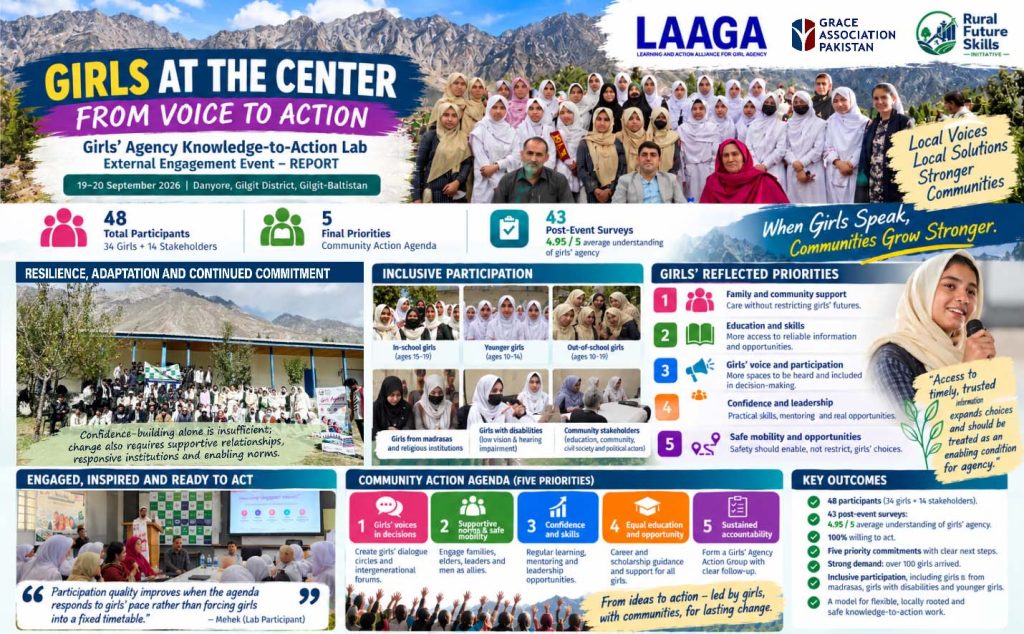
GRACE Association and LAAGA Turn Girls’ Voices into Community Action in Gilgit-Baltistan

Girls’ Agency Knowledge-to-Action Lab and Intergenerational Policy Dialogue | Danyore, Gilgit | 19 to 20 September 2026

An inspiring journey of resilience, girl-centered learning, local partnership and shared commitments to strengthen girls’ agency in northern Pakistan.

Bringing Girls’ Voices to the Center

Danyore, Gilgit-Baltistan: GRACE Association Pakistan, in collaboration with the Learning and Action Alliance for Girls’ Agency (LAAGA) and the girls-led Rural Future Skills Initiative (RFSI), successfully organized the “Girls at the Center: From Voice to Action for Girls’ Agency” initiative in Danyore, Gilgit.

The event engaged 48 participants, including 34 adolescent girls and young women and 14 community stakeholders, to explore girls’ aspirations, identify barriers and enabling conditions, and develop a shared Girls’ Agency Action Agenda.

Led by Khadim Hussain, CEO of GRACE Association, founding member of LAAGA and 2012 Echidna Global Scholar, the initiative aimed to translate LAAGA’s research and Girl-Centered Methodology into meaningful local dialogue and practical community action.

LAAGA is a global community of practice comprising 23 leaders from 18 countries, working to advance gender equality in and through education. Its approach recognizes girls as knowledgeable individuals capable of shaping their lives and contributing to their communities.

The initiative carried a simple message:

“When girls speak, communities grow stronger.”

From an Interrupted Mountain Journey to an Opportunity

Originally planned for Immit village in Ghizer district, the initiative responded to a request from RFSI, a newly established girls-led grassroots organization.

A three-member GRACE team travelled more than 275 kilometers from Skardu towards Immit. However, heavy rain, landslides and a truck blocking a narrow mountain road made further travel unsafe. The team returned to Gilgit.

Rather than cancelling the activity, Shafiqa Sakhi, the young leader of RFSI and a former GRACE programme alumna, encouraged an alternative arrangement.

Through her efforts, a school in Danyore agreed to host the event. Its principal, Ms. Samina, generously provided the venue and helped mobilize participants.

This unexpected change demonstrated how committed local leadership, strong partnerships and flexibility can turn challenges into opportunities.

An Overwhelming Response from Girls

The organizers initially planned a participatory Lab for 15 to 20 girls. However, more than 100 adolescent girls and young women arrived, eager to participate.

To ensure meaningful engagement, facilitators explained the importance of smaller groups in Girl-Centered Methodology. Ultimately, 34 girls participated actively.

The session extended beyond its planned duration because the girls were deeply engaged in sharing their experiences, aspirations, concerns and ideas.

Through storytelling, reflection and participatory exercises, particularly the bridge exercise, girls explored their current realities, imagined their desired futures and identified the barriers they needed to overcome.

They also identified the people and institutions that could help them cross that bridge.

The discussions generated important insights into the barriers and enabling conditions shaping girls’ agency.

What We Learned from the Girls

  1. Girls need regular opportunities to speak and be heard.

Girls expressed a strong desire for safe, respectful spaces where they could share ideas, discuss challenges and participate in decisions affecting their lives.

One-time events are not enough. Schools and communities need regular girls’ dialogue forums, mentoring opportunities and intergenerational conversations.

  1. Safe mobility determines access to opportunities.

Girls highlighted how restrictions on movement can limit access to education, training, scholarships and community participation.

Families’ safety concerns are genuine. However, protection should involve practical solutions, including safe transport, trusted arrangements and supportive community environments, rather than unnecessary restrictions.

  1. Education must lead to further opportunities.

Girls emphasized the importance of continuing education beyond school, including access to universities, technical institutions, professional training and scholarships.

They particularly highlighted unequal treatment when girls receive scholarships outside their hometowns. While sons may be encouraged to travel, daughters sometimes face restrictions because of safety concerns and social expectations.

Families and institutions should work together to make these opportunities safe and accessible.

  1. Access to reliable information and practical skills is essential.

Limited information about scholarships, educational pathways, training and career opportunities emerged as an important barrier.

Girls also identified the need for communication, negotiation, decision-making, problem-solving, digital literacy and leadership skills.

Schools, mentors and community organizations can help connect girls with information, positive role models and practical opportunities.

  1. Families and communities can become powerful enablers.

The discussions recognized that parents and communities care deeply about girls. However, excessive protection can sometimes unintentionally restrict their choices.

Supportive fathers, mothers, brothers, teachers, elders and community leaders can make a significant difference by encouraging education, facilitating safe mobility and respecting girls’ aspirations.

The central lesson was clear: Care should protect a girl’s future, not close the door on it.

From Girls’ Voices to a Shared Action Agenda

The Lab moved beyond identifying problems.

Using LAAGA’s Girl-Centered Methodology, participants explored practical solutions and identified responsibilities for families, schools, communities, government institutions, civil society and media.

A subsequent intergenerational dialogue brought together 14 community participants, including educators, the school principal, parents and social activists.

Participants discussed the girls’ priorities, reviewed the proposed Girls’ Agency Action Agenda 2026, and endorsed it.

The Agenda emphasizes five shared commitments:

  1. Listen: Establish regular, safe spaces for girls’ voices and meaningful participation.
  2. Support: Engage families and communities in encouraging girls’ aspirations and safe mobility.
  3. Enable: Expand access to education, scholarships, reliable information, practical skills and mentoring.
  4. Include: Strengthen girls’ participation in school and community decision-making.
  5. Act: Promote institutional responsibility, community ownership and follow-up on agreed commitments.

RFSI and participating girls will share the Action Agenda with parents, community elders, leaders and other stakeholders to encourage wider dialogue and endorsement.

The intention is to make it a living community document, rather than an output that ends with the event.

Key Lessons for GRACE and Its Partners

The experience generated important lessons for future community engagement.

Girl-centered approaches produce deeper understanding. When girls receive sufficient time, trust and opportunities to participate, they can identify their challenges and propose realistic solutions.

Girls’ agency is relational and systemic. Confidence matters, but supportive families, responsive schools, safe environments and accessible opportunities are equally important.

Local partnerships strengthen ownership. RFSI’s leadership and the host school’s cooperation were essential in adapting and delivering the initiative.

Flexibility strengthens grassroots action. Unexpected travel disruptions became an opportunity to engage a wider group of girls in Danyore.

Dialogue needs practical follow-up. Shared commitments, responsible stakeholders and continued participation by girls are necessary to turn learning into lasting change.

Looking Ahead: Sustaining Girls’ Agency

GRACE Association aims to build on this experience by encouraging wider community endorsement of the Action Agenda, strengthening local partnerships and exploring opportunities to replicate Girl-Centered Knowledge-to-Action Labs in other communities.

The initiative also contributes practical learning to LAAGA’s broader efforts to connect research, community knowledge and locally owned action.

Above all, the experience reinforced a powerful message:

Girls are not simply beneficiaries of development. They are knowledgeable, capable partners in shaping solutions for their families and communities.

When we listen to girls, provide reliable information, support their choices and remove unnecessary barriers, we create opportunities for everyone to thrive.

When girls speak, communities learn. When girls are supported to act, communities grow stronger.

_____________

GRACE Association Pakistan | Advancing inclusive education, girls’ agency, youth empowerment and community-led development.

GRACE Association Pakistan and Rotary Club Pakistan Mark International Literacy Day 2026 with Student-Led Awareness Walk in Skardu

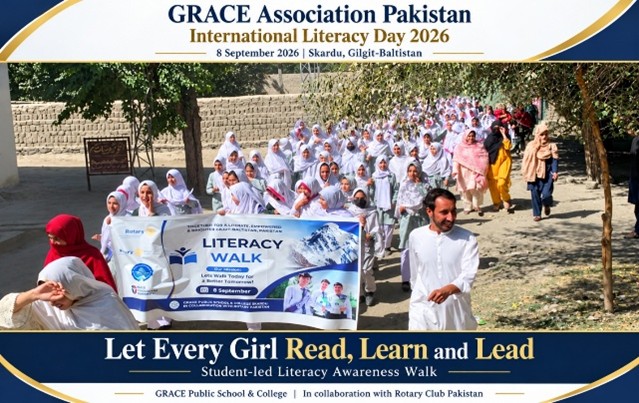
Skardu, Gilgit-Baltistan | 8 September 2026 — GRACE Association, in collaboration with Rotary Club Pakistan, commemorated International Literacy Day 2026 at GRACE Public School & College (GPSC), Skardu, with a vibrant student-led Literacy Awareness Walk, reinforcing the message that literacy is a fundamental human right and a foundation for inclusive and sustainable development.

Marking the 60th anniversary of International Literacy Day, the event highlighted the importance of “Literacy for People, Our Planet and Prosperity for All” and mobilized students, teachers and community members around a shared commitment to ensure that every child—girl or boy—has opportunities to read, learn and thrive.

Students Took the Message to the Community

Around 500 GPSC students, accompanied by teachers and staff, participated in the awareness walk. Beginning at GRACE Public School & College, the procession moved along the Main Skardu Airport Road and through nearby communities, carrying banners and student-made placards while chanting powerful literacy messages.

“Every Child Reads, Every Child Leads,” “Let Every Girl Read, Learn and Lead,” “Read Today, Lead Tomorrow,” “Raise Pens, End Ignorance,” “Literacy Today, A Brighter Tomorrow,” and “Books in Hand, Dreams at Heart” were among the messages in Urdu and local language echoing through the community.

The walk attracted considerable public attention. Community members gathered along the route, while some residents watched and listened from their rooftops as students advocated for education and called for collective action to reach children who remain out of school.

From Awareness to Action

Following the walk, a student assembly provided young advocates and teachers with an opportunity to reflect on the meaning of literacy. Speakers emphasized that literacy is more than the ability to read and write—it enables people to participate meaningfully in society, make informed choices, pursue opportunities and contribute to resilient communities.

Students and staff also pledged to extend the spirit of Literacy Day beyond the event by supporting children and family members in their neighborhoods to strengthen reading and learning skills, demonstrating how individual action can contribute to broader community change.

The initiative complements the ongoing GRACE School Literacy Acceleration Campaign, which is currently engaging nine BS Education students from the University of Baltistan at GRACE Public School Skardu to contribute to literacy and learning improvement efforts.

Literacy as a Shared Responsibility

The celebration reinforced GRACE Association’s belief that achieving literacy for all requires collaboration among schools, families, communities, government, universities, civil society and development partners. Equal opportunities for girls and boys remain central to this commitment.

Through the Literacy Day Walk and continuing literacy initiatives, GRACE Association and its partners aim to transform awareness into practical grassroots action—helping communities recognize that educating every child strengthens not only individual futures, but families, communities and the society.

Every Child Reads. Every Child Leads.
Literacy Today. A Brighter Tomorrow.

GRACE Public School & Access Centers Mark World Disability Day 2025 with a Renewed Commitment to Inclusion

GRACE Public School & Access Centers Mark World Disability Day 2025 with a Renewed Commitment to Inclusion

Skardu, Baltistan – 3 December 2025
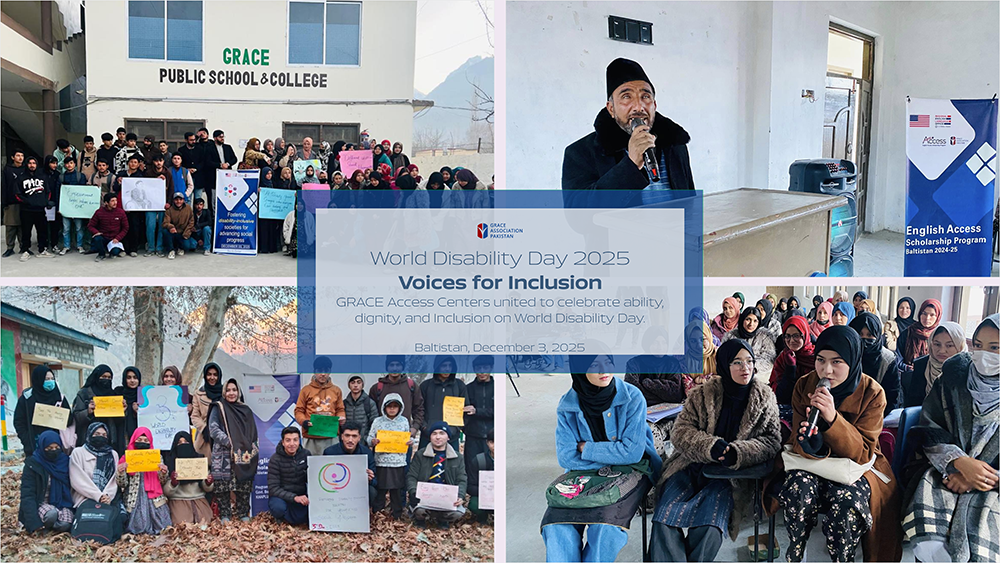
GRACE Public School & College (GPSC) and GRACE Access Program Centers across Baltistan commemorated World Disability Day 2025 with coordinated, student-centered events reaffirming their dedication to inclusive, dignified, and rights-based education for children and youth with disabilities.

Activities were held simultaneously at GPSC Skardu and Access Centers in Khaplu and Shigar, bringing together students, teachers, parents, community leaders, and volunteers. The events featured student speeches, storytelling, posters, discussions on disability rights, and reflections promoting empathy and respect for diversity.

Celebrating Ability, Dignity & Diversity

At GRACE Public School, students led an inspiring assembly, sharing poems, reflections, and awareness posters advocating for equal rights and accessible learning spaces.
The Skardu Access Center hosted renowned visually impaired vocalist Abbas Abdal as chief guest, who shared his journey and performed soulful Sufi kalams, inspiring students with his resilience and talent.

Across Khaplu and Shigar Centers, learners engaged in:
• Speeches addressing stereotypes and discrimination
• Poster and slogan-writing on inclusion
• Reading circles featuring stories of change-makers with disabilities
• A tribute sketch by student Ahmad Ruhullah honoring Mr. Khadim Hussain, CEO GRACE Association Pakistan, for promoting inclusive education and youth empowerment despite his own disability

Voices of Courage and Hope

Students shared personal stories, highlighting challenges and aspirations.
Muhammad Abdullah, a young boy with a mobility disability, said, “People should not decide how far I can study. I will continue my education—accessible schools make it possible.”

Teachers emphasized the need for continuous professional development, accessible classrooms, and empathy-driven teaching strategies to ensure all learners thrive.

A Shared Community Responsibility

GRACE coordinators and management stressed that inclusion is a collective duty of families, schools, communities, and policymakers. The GPSC Principal noted, “Every ramp, every accessible lesson, and every child encouraged to speak brings us closer to a Baltistan where no learner is left behind.”

Participants pledged to advocate for inclusive attitudes at home and in community spaces while supporting improved infrastructure and services for people with disabilities.

From Awareness to Year-Round Action

GRACE institutions concluded the day by endorsing a five-point pledge to:

  1. Enhancing physical accessibility in schools
  2. Strengthening teacher training in inclusive pedagogy
  3. Amplifying student leadership for learners with disabilities
  4. Engaging parents and communities in dialogue
  5. Building partnerships to expand education, skills, and livelihood opportunities for youth with disabilities

Through these commitments, GRACE aims to transform the spirit of World Disability Day into sustained action—creating a Baltistan where every learner, regardless of ability, can grow, succeed, and thrive.