
Girls’ Agency Knowledge-to-Action Lab and Intergenerational Policy Dialogue | Danyore, Gilgit | 19 to 20 September 2026
An inspiring journey of resilience, girl-centered learning, local partnership and shared commitments to strengthen girls’ agency in northern Pakistan.
Bringing Girls’ Voices to the Center
Danyore, Gilgit-Baltistan: GRACE Association Pakistan, in collaboration with the Learning and Action Alliance for Girls’ Agency (LAAGA) and the girls-led Rural Future Skills Initiative (RFSI), successfully organized the “Girls at the Center: From Voice to Action for Girls’ Agency” initiative in Danyore, Gilgit.
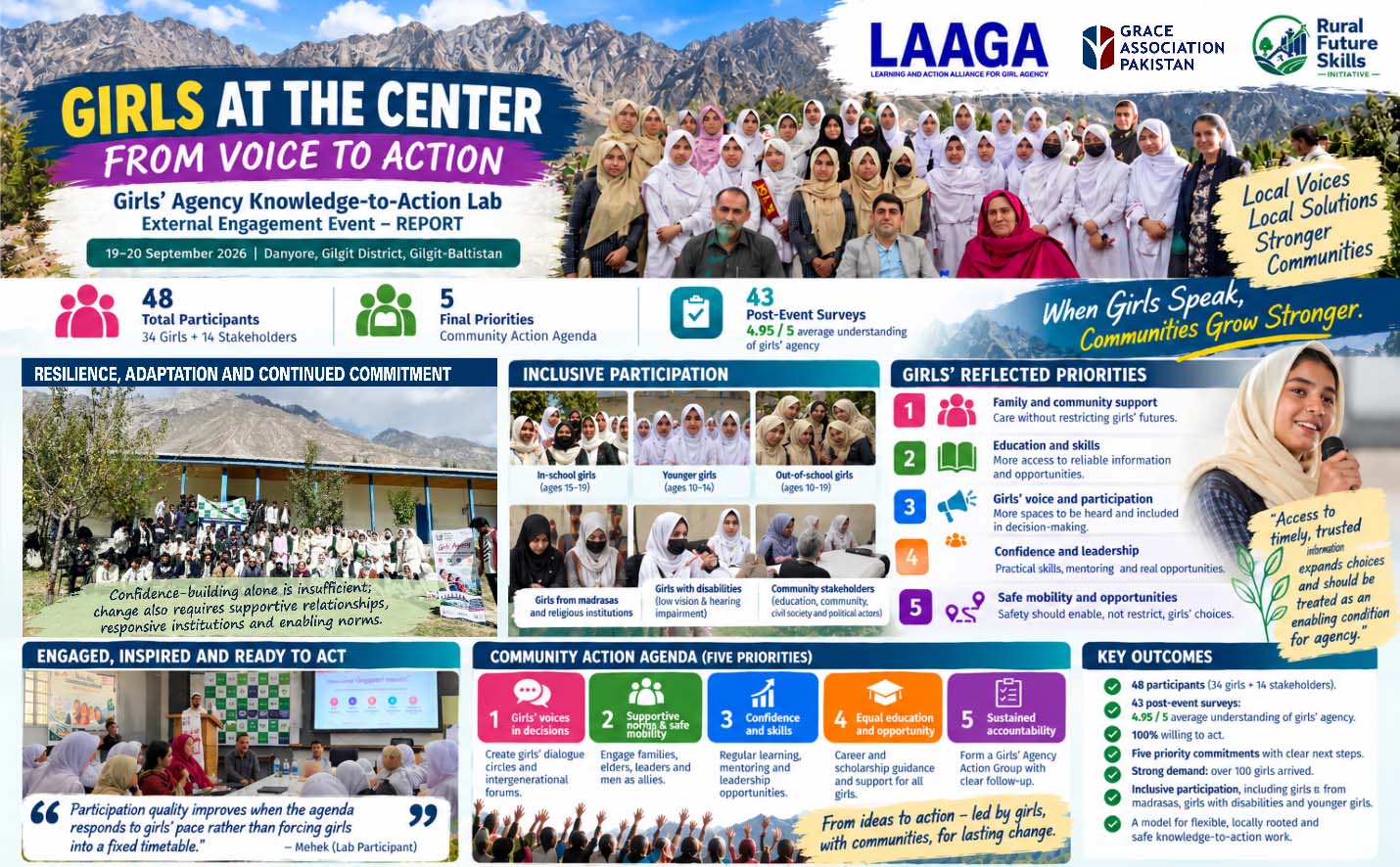
The event engaged 48 participants, including 34 adolescent girls and young women and 14 community stakeholders, to explore girls’ aspirations, identify barriers and enabling conditions, and develop a shared Girls’ Agency Action Agenda.
Led by Khadim Hussain, CEO of GRACE Association, founding member of LAAGA and 2012 Echidna Global Scholar, the initiative aimed to translate LAAGA’s research and Girl-Centered Methodology into meaningful local dialogue and practical community action.
LAAGA is a global community of practice comprising 23 leaders from 18 countries, working to advance gender equality in and through education. Its approach recognizes girls as knowledgeable individuals capable of shaping their lives and contributing to their communities.
The initiative carried a simple message:
“When girls speak, communities grow stronger.”
From an Interrupted Mountain Journey to an Opportunity
Originally planned for Immit village in Ghizer district, the initiative responded to a request from RFSI, a newly established girls-led grassroots organization.
A three-member GRACE team travelled more than 275 kilometers from Skardu towards Immit. However, heavy rain, landslides and a truck blocking a narrow mountain road made further travel unsafe. The team returned to Gilgit.
Rather than cancelling the activity, Shafiqa Sakhi, the young leader of RFSI and a former GRACE programme alumna, encouraged an alternative arrangement.
Through her efforts, a school in Danyore agreed to host the event. Its principal, Ms. Samina, generously provided the venue and helped mobilize participants.
This unexpected change demonstrated how committed local leadership, strong partnerships and flexibility can turn challenges into opportunities.
An Overwhelming Response from Girls
The organizers initially planned a participatory Lab for 15 to 20 girls. However, more than 100 adolescent girls and young women arrived, eager to participate.
To ensure meaningful engagement, facilitators explained the importance of smaller groups in Girl-Centered Methodology. Ultimately, 34 girls participated actively.
The session extended beyond its planned duration because the girls were deeply engaged in sharing their experiences, aspirations, concerns and ideas.
Through storytelling, reflection and participatory exercises, particularly the bridge exercise, girls explored their current realities, imagined their desired futures and identified the barriers they needed to overcome.
They also identified the people and institutions that could help them cross that bridge.
The discussions generated important insights into the barriers and enabling conditions shaping girls’ agency.
What We Learned from the Girls
- Girls need regular opportunities to speak and be heard.
Girls expressed a strong desire for safe, respectful spaces where they could share ideas, discuss challenges and participate in decisions affecting their lives.
One-time events are not enough. Schools and communities need regular girls’ dialogue forums, mentoring opportunities and intergenerational conversations.
- Safe mobility determines access to opportunities.
Girls highlighted how restrictions on movement can limit access to education, training, scholarships and community participation.
Families’ safety concerns are genuine. However, protection should involve practical solutions, including safe transport, trusted arrangements and supportive community environments, rather than unnecessary restrictions.
- Education must lead to further opportunities.
Girls emphasized the importance of continuing education beyond school, including access to universities, technical institutions, professional training and scholarships.
They particularly highlighted unequal treatment when girls receive scholarships outside their hometowns. While sons may be encouraged to travel, daughters sometimes face restrictions because of safety concerns and social expectations.
Families and institutions should work together to make these opportunities safe and accessible.
- Access to reliable information and practical skills is essential.
Limited information about scholarships, educational pathways, training and career opportunities emerged as an important barrier.
Girls also identified the need for communication, negotiation, decision-making, problem-solving, digital literacy and leadership skills.
Schools, mentors and community organizations can help connect girls with information, positive role models and practical opportunities.
- Families and communities can become powerful enablers.
The discussions recognized that parents and communities care deeply about girls. However, excessive protection can sometimes unintentionally restrict their choices.
Supportive fathers, mothers, brothers, teachers, elders and community leaders can make a significant difference by encouraging education, facilitating safe mobility and respecting girls’ aspirations.
The central lesson was clear: Care should protect a girl’s future, not close the door on it.
From Girls’ Voices to a Shared Action Agenda
The Lab moved beyond identifying problems.
Using LAAGA’s Girl-Centered Methodology, participants explored practical solutions and identified responsibilities for families, schools, communities, government institutions, civil society and media.
A subsequent intergenerational dialogue brought together 14 community participants, including educators, the school principal, parents and social activists.
Participants discussed the girls’ priorities, reviewed the proposed Girls’ Agency Action Agenda 2026, and endorsed it.
The Agenda emphasizes five shared commitments:
- Listen: Establish regular, safe spaces for girls’ voices and meaningful participation.
- Support: Engage families and communities in encouraging girls’ aspirations and safe mobility.
- Enable: Expand access to education, scholarships, reliable information, practical skills and mentoring.
- Include: Strengthen girls’ participation in school and community decision-making.
- Act: Promote institutional responsibility, community ownership and follow-up on agreed commitments.
RFSI and participating girls will share the Action Agenda with parents, community elders, leaders and other stakeholders to encourage wider dialogue and endorsement.
The intention is to make it a living community document, rather than an output that ends with the event.
Key Lessons for GRACE and Its Partners
The experience generated important lessons for future community engagement.
Girl-centered approaches produce deeper understanding. When girls receive sufficient time, trust and opportunities to participate, they can identify their challenges and propose realistic solutions.
Girls’ agency is relational and systemic. Confidence matters, but supportive families, responsive schools, safe environments and accessible opportunities are equally important.
Local partnerships strengthen ownership. RFSI’s leadership and the host school’s cooperation were essential in adapting and delivering the initiative.
Flexibility strengthens grassroots action. Unexpected travel disruptions became an opportunity to engage a wider group of girls in Danyore.
Dialogue needs practical follow-up. Shared commitments, responsible stakeholders and continued participation by girls are necessary to turn learning into lasting change.
Looking Ahead: Sustaining Girls’ Agency
GRACE Association aims to build on this experience by encouraging wider community endorsement of the Action Agenda, strengthening local partnerships and exploring opportunities to replicate Girl-Centered Knowledge-to-Action Labs in other communities.
The initiative also contributes practical learning to LAAGA’s broader efforts to connect research, community knowledge and locally owned action.
Above all, the experience reinforced a powerful message:
Girls are not simply beneficiaries of development. They are knowledgeable, capable partners in shaping solutions for their families and communities.
When we listen to girls, provide reliable information, support their choices and remove unnecessary barriers, we create opportunities for everyone to thrive.
When girls speak, communities learn. When girls are supported to act, communities grow stronger.
_____________
GRACE Association Pakistan | Advancing inclusive education, girls’ agency, youth empowerment and community-led development.
